Office Politics: Everyone Hates It, Nobody Talks About It
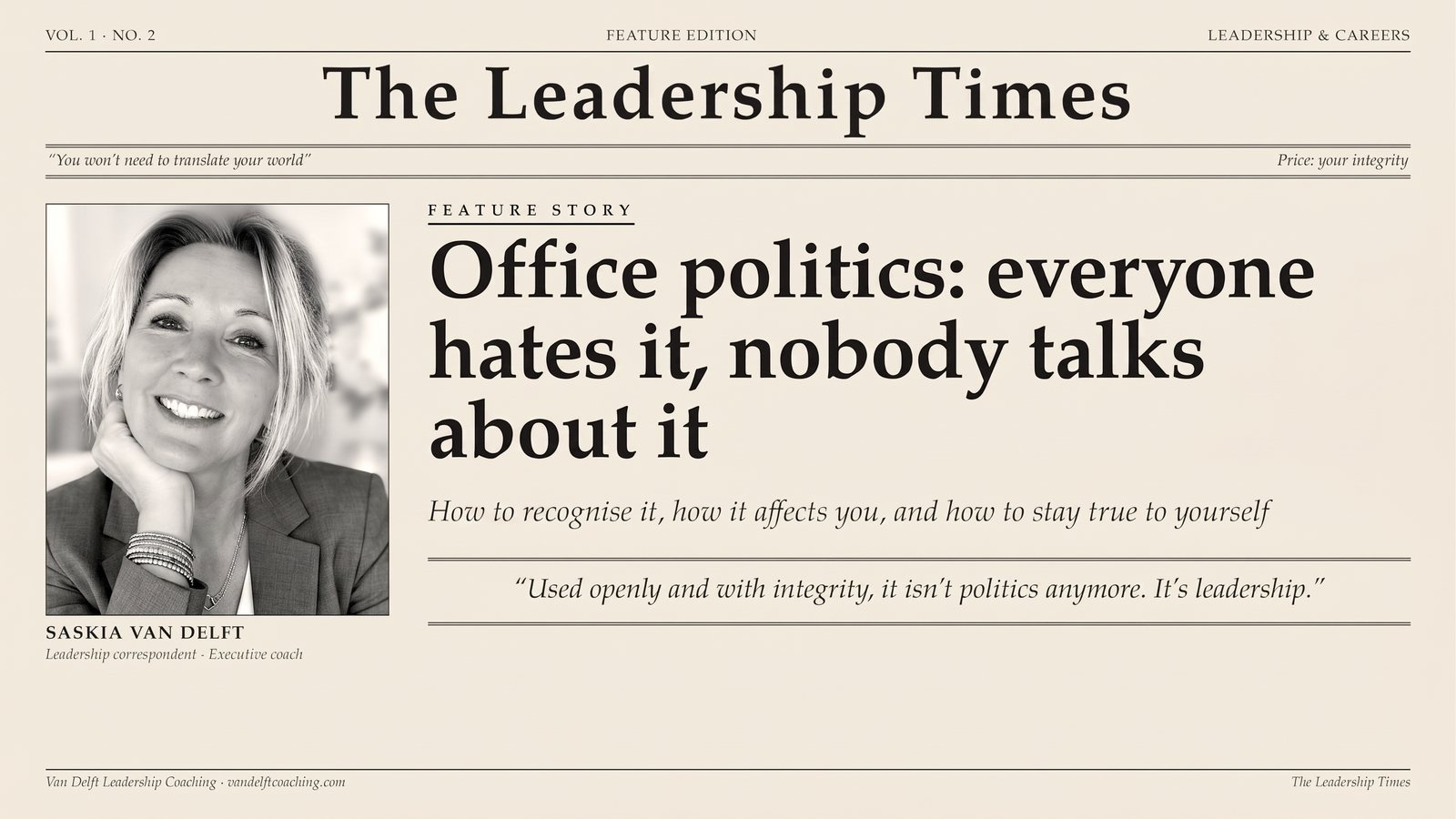
How to recognise it, how it affects you, and how to stay true to yourself.
Ask anyone what they dislike most about work, and "office politics" will be near the top of the list. Yet it's one of the few things we almost never talk about openly. We roll our eyes, we sigh at the coffee machine, and then we carry on as if it's just the way things are.
So let's talk about it.
What are office politics, really?
MindTools describes office politics as "the use of underhand methods to gain advantage in the workplace." People do it to reach their goals, gain prestige or increase their influence.
The article makes an important distinction. Building relationships and persuading others is normal and healthy. It becomes politics when people use manipulation, backbiting or infighting instead.
Kathleen Kelley Reardon, writing in Harvard Business Review, describes four types of organisation: minimally, moderately, highly and pathologically political. In a highly political organisation, who you know matters more than what you know, and there's usually an "inner circle". At the extreme end, the whole environment is marked by distrust.
7 signs of office politics
You've probably seen most of these behaviours:
- Gossip: talking about people who aren't in the room instead of talking about the work.
- Silos: information and resources held back to keep power.
- Rivalry: more focus on personal wins than on team success.
- Power plays: using connections to get ahead, regardless of skill.
- Blame: shifting responsibility instead of taking it.
- Discrediting others: making someone else look bad to look better yourself.
- Not saying what you mean: nodding in the meeting and saying something completely different afterwards.
How office politics hurts you and your organisation
The cost of office politics is bigger than we admit:
- Promotions based on connection, not merit. When the people who get ahead are the ones who know the right people, talented people lose faith, and often leave.
- The old boys' club. Decisions are made on the golf course, at the bar or in the WhatsApp group you're not part of. For many women and people from different backgrounds, this is still a real barrier.
- Hidden agendas. When people don't say what they mean, trust disappears. You spend energy working out what's really going on instead of doing your job.
- Stress and burnout. Politics leads to frustration over perceived unfairness, lower morale, and in the end stress and burnout. The workplace can become toxic.
And here's the impact you may not notice. Politics changes you. You become more careful, you say less, you second-guess yourself. Without realising it, you start playing a game you never wanted to play.
How to deal with office politics without losing yourself: 11 strategies
You can't always avoid politics. But you can choose how you respond to it.
Start with yourself
1. Stay true to your values
This is your anchor. Ask yourself: what kind of leader do I want to be, even when others play the game? Your values make difficult choices easier.
2. Walk the talk
Set the example you want to see. Communicate consistently and openly, listen, and look for win-win outcomes rather than personal wins. Reward good teamwork, and give feedback when behaviour crosses the line. Your team copies what you do, not what you say.
3. Be transparent about not playing
Be open about the fact that you don't engage in political behaviour. Say what you mean, share information, and give credit where it's due. Over time this builds a kind of trust that politics never can.
4. Keep your eyes on the goal
When conflict arises, don't take sides. Bring the conversation back to what everyone should agree on: the success of the team and the organisation.
Deal with what you see
5. Talk about it openly
Politics thrives in silence. Name it, with your team, your peers or your manager: "I have the feeling decisions are being made outside this meeting. Can we talk about that?" It takes courage, but it often brings relief.
6. Stop gossip early
Don't join it, and don't let it spread. Talk to the people involved to find out what's really going on. Sharing stories about colleagues always comes back to you, and lost trust is hard to win back.
7. Never accept bullying
Bullying is sometimes disguised as "just politics", but it never is. If it happens to you or someone in your team, follow your organisation's policy, record what happens, and don't be afraid to take formal action.
8. Keep written records
Write down your ideas, suggestions and achievements, for example in a dated email. If you run into difficult behaviour, note the specific incidents. If HR or your manager ever needs to step in, you'll have the facts.
Build your influence the right way
9. Know who really has influence
Job titles don't always show where the power is. Influence often lies with the people others listen to. Learn who they are, what they care about and how you can work with them. That's not playing politics. That's being smart.
10. Build real alliances
Don't only focus on your own work. Invest in relationships across levels and departments, find allies who support you, and find a mentor who helps you avoid the pitfalls. Base it on genuine connection, not on what someone can do for you.
11. Know when to leave
If an organisation is so political that it goes against everything you stand for, and nothing changes, it may be time to move on. Your wellbeing and integrity are worth more than any title.
Is there a positive side to office politics?
Yes, if you look at it differently.
The skills behind "good" politics are the same skills every senior leader needs: understanding your stakeholders, building relationships, knowing how decisions are really made, and influencing people without formal authority.
The difference lies in intention. Are you using your influence to benefit the team, the organisation and the people around you? Or to benefit yourself at someone else's expense?
When you use these skills openly and with integrity, they aren’t politics anymore. They’re leadership.
This is where coaching helps
Many of the leaders I coach struggle with exactly this. They're very good at their work, but feel overlooked because they don't want to play the political game. Together we look at how they can build influence and visibility without compromising their values. That often turns out to be the most powerful position of all.
Over to you: how do you deal with politics at work? Have you found a way to stay true to yourself? Send me a message. I read every one.
Inspired in part by MindTools: Working in a highly political organization, which builds on the work of Kathleen Kelley Reardon in Harvard Business Review.

Saskia van Delft is an Accredited Executive Coach with the Association for Coaching and a graduate of the Advanced Executive Coaching Programme at the Møller Institute, University of Cambridge. A former KLM flight attendant and International Head of HR, she coaches senior leaders in English and Dutch. More about Saskia.